Small Conceits

Musings. Stories. Poems.


4 Comments

The Itch that Launched a New Life

I don’t know exactly where it started:

The itch that became a wondering.

The wondering that became a flickering idea.

The flickering idea that sputtered and sparked until it caught, blazing through my life like a wildfire of change.

I’d been scratching at that nagging itch for years, trying to satisfy it with flower beds and backpacking and kayaking and all manner of seeking connection with the natural world. But it seemed a moving target, always just out of reach. And then one day, standing in front of a wide bookcase, staring at a significant collection of books I’d accumulated about solar and wind power and collecting rainwater and foraging for wild food and organic gardening and building twig furniture and making dyes from plants and constructing decks and cabins and cob houses…and I asked myself:

Why am I just reading about all of this? Why aren’t I living it?

I took a long, deep breath. Why, I wondered, did I spend so much time dreaming about things and so little time actually doing them?

Oh, it’s not that I don’t do stuff. I’ve hiked and backpacked and camped — often solo — in the Badlands of South Dakota, the Canyonlands of Utah, through the sequoias of northern California, on the lakeshores and prairies of Minnesota, in the mountains of Colorado, and across the diverse ecosystems of Washington state. I bought my own house and lived alone in it for years. I jumped the corporate ship and landed safely — albeit somewhat shakily — on the deck of my very own freelancing business. Yes, I’ve taken myself on adventures, some of them scary, but I always seemed to return to my safe, convenient life in the city. And, try as I might, I could never quite put down roots.

My roots still felt like they were sunk deep in the soil of my rural childhood. I looked at that shelf of books and saw fallow dreams, forgotten values. I calculated my finances (woefully lacking), took stock of my health (fraying at the edges), and considered my career opportunities (fading with age), and decided the hell with it.

If I don’t do something now, I’ll never do it. I’d stalled long enough.

Without pausing to think, I started striding down the path to a new way of living. I knew it would test my mettle, my courage, and my determination. The books on the shelf were a mere outline, not a plan. I’d plan as I went, I decided. I’d remain open and flexible. I’d follow my intuition.

To where, I had no idea.

But suddenly I was purging possessions, selling my house, and searching for a slice of rural mountain property on which to put down my roots.

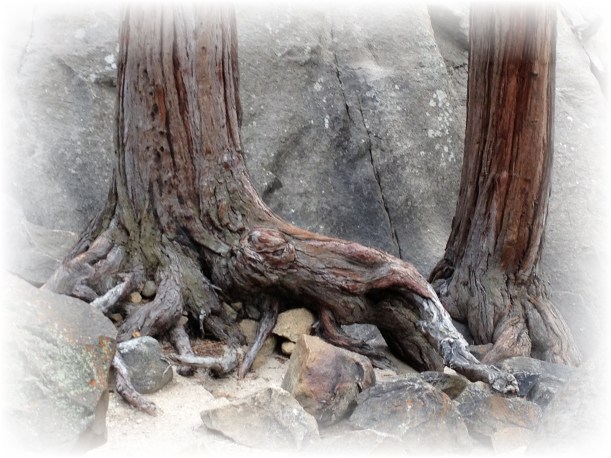
roots


2 Comments

A Farewell Gift from the Queen

Her beautiful skin belies her age, but I can see that some of the light has gone out of her eyes. I smile quietly as she carefully locks and bolts the door behind me, a complicated process with many steps. 

At her request, I’d crossed my yard and climbed her steep front stairway so she could bestow upon me a farewell gift. I now stood in her living room, my first invitation into her inner sanctum in the 13 years I’ve lived here. Thick drapes are drawn closed, protecting her furnishings from fading and rendering the crowded little room dim.

“I got these for you,” she said breathily with an excited little flutter of her hands. She produced a flowery gift bag from the sofa behind her, then unpacked it for me so she could bask a little in my appreciation. Her enthusiasm was beautifully childlike. I oohhhed and aahhhed over each gift, especially the last.

“I don’t think you’ll need sweaters in North Carolina,” she said, dipping her hand into the bag to pull out a pile of paisley material in lovely shades of blue and streaked with silver threads. “But I thought you’d like this shawl,” she finished and held it out to me to admire. The sweetness of her perfume wafted from the fabric, and I thanked her warmly. I loved her taste in scarves and shawls. I always wore the ones she gifted to me.

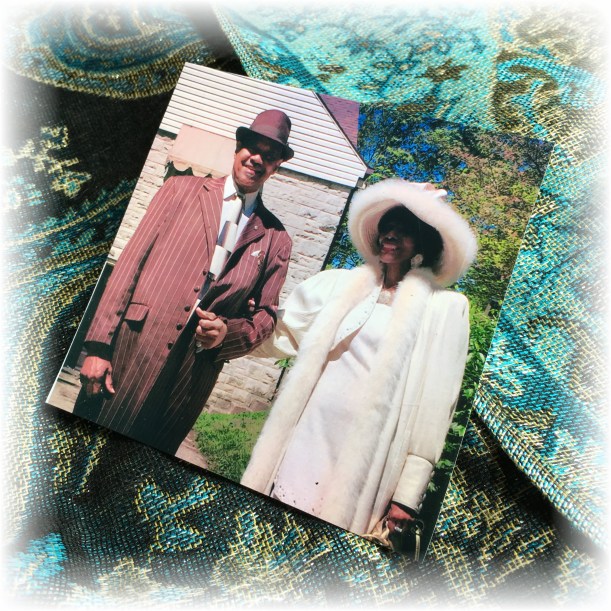
“Did Larry get a copy of that photo to you?” I asked, referring to a photo I’d taken of her and the man whose elderly mother lives across the street.

“He sure did!” she said, beaming and reaching for a frame perched on an end table. She turned it so I could see the photograph it held, and there they were: Queen Annette of the Ivy Castle and Lawrence, Duke of Graceland, standing as I’d captured them, arm in arm in their Sunday finery. As she turned the frame back again so she could see the photo, her smile softened and her voice lowered. “He sure did,” she repeated, this time with a deep fondness.

I paused for a moment, my own fondness melting into hers. “I’m going to miss Sundays here the most,” I said. “Do you know why?” She cocked her head a little, curiously, her dazzling smile lighting the dim room. “Because,” I explained, “I won’t get to see you drifting down those stairs anymore, wearing those gorgeous dresses with the matching high-heeled shoes and hats. You look like someone from a fairytale when you’re dressed for church.”

“Oh, you!” she giggled, waving me away but clearly enjoying the compliment. “I’m going to miss you, too,” she told me, growing more serious. “You’ve always been so kind. You take good care of me.” And she wrapped me in a perfumed hug, her thin body so much more frail than it looked. She was a sweet and dainty bird, perched in her high fortress on the hill.

It took a few moments for her to unlock all the bolts on the door to let me out again into the sunlight and heavy summer air. She hugged me again, and I turned to go.

“I love you, baby,” she said as she held the door for me. Her words stopped me in my tracks. “I love you, too, Mrs. Peterson,” I replied, turning for just a moment to look into her deep brown eyes before continuing on down the stairs, tears wetting my lashes.

She’s never said those words aloud to me before. But I’ve always, always felt them.


Leave a comment

Shape-Shifting

I do not bring back from a journey quite the same self that I took.

— W. Somerset Maugham


We are taught to believe

in the “to” and the “from”-ness of traveling —

fixed places in space and time

lines on a map

comfortingly measurable

embarked upon by some predictable

knowable definable “self”


But, oh…this journey of mine

of blood and bone

of flesh and spirit

of mind and mystery —

this journey is a spiral dance


I turn: a Selkie’s pelt for skin

I turn: an owl’s feathers for hair

I turn: darkness for a face

and my teeth in a grin of moon-change

I turn and turn and turn:

wind for a name

tides for a heart

tall pines to hold sinew to muscle of clouds


Not the how —

only the what and the why,

not the where or the when

or the “I”

that isn’t


This journey of mine

will bring no self home

changed or unchanged

because the destination

is no horizon


Leave a comment

Strawberry Moon

The punchline

{Who cooks for you? Who? Who cooks for you?}

nearly

escaped

me.

——

In my one hand,

the map to a dream —

my heart a fluttering sparrow

as my boots thumped the wild

mountain road at its border,

tangled with grass and mud

and blackberry vines.

The songs of warblers in the air,

and crowsfoot

garlanding the west slope

under patiently watching pines.


We were talking and not talking

in waves as we drifted

along the western boundary.

He swooped momentarily out of view

reappearing a moment later,

extending a gift from his sudden dive:

a striped feather,

almost bulbous at the shaft

and narrowing to its ragged tip.


“This is for you,” he told me.

“Hawk. No…turkey,”

he said, brow furrowed.

“I always confuse them.”

But as it crossed my empty palm,

the feather whispered:


{barred owl}


The pines sighed in the breeze.

Strangely shaken, I thanked him

and tucked his gift tenderly

into the nest of my backpack.


I retrieved the map from the pocket

I’d folded it into, a wrinkled square.

It felt strangely warm in my hand

after the feather.

I let my fingers trace its lines,

feeling the leathery stirring

of bat wings from a shaman’s dream

deep in my chest.


{Something I must do —

something to gather,

another to release —

to redraw this map

and claim my Home.}


Later, back in my room,

I searched for confirmation

from Turkey, from Hawk.

But the finding…the finding:

the wrong territory,

an unlikely answer, improbable but

unmistakable:

Barred Owl.


Across the thinning veil

of dreamstime and magic,

Bat lazily woke to scold me,

opening only one eye

and yawning his impatience:


{Why would you think

the feather didn’t know? 

Child: Leave behind

this doubting mind of yours.

Shed this foreign skin.

Follow the feather home

to your heart.}


Light pierced a crack in the curtains

and lit the map, lying on my bed,

its creases carefully smoothed flat,

the feather lying across it:

a Strawberry Moon,

full and bright and ripe

with possibility.


A ceremony was circling.

I twined my fingers

with the moon’s around the feather

and began.

——

And the joke

{my heart did not know

to be hungry

for this land}

is

on

me.


Leave a comment

Esther Be Gather, Indianapolis – Part 2: The Talk

In “Esther Be Gather, Indianapolis – Part 1: The Poem,” I provide context for the talk that appears below, as well as the poem to which it refers. I separately posted the emotional energy of the poem from the intellectualized content of the talk below, partly to give the poem its own space, where the intensity of its story could be experienced without the buffering offered by its intellectual explication. I wanted the reader to sit with the emotional impact for a moment, without heading into the relative “safety” we construct for ourselves by detaching from our emotions, objectifying the causes, and picking them apart under the sanitized glare of analysis and theory.

The poem focuses on only one of the events that — unbeknownst to me, for much of my life — shaped how I relate to the world and my place in it. The topic of molestation is a difficult one. But, for far too many women — and men — in the world, so is living with the shame of the experience. I’m fortunate. My family didn’t try to hide the event from me; in fact, we talked openly about it. Still, its effects ripple through my life in ways I haven’t always recognized or clearly understood. It wasn’t until I wrote the poem and stood in front of an audience to talk about it that connections to some of the beliefs I have about myself and some of the choices I’ve made in my life began to cohere for me. Many of my wounds have healed, scarred over. But even scars can pinch and pull when we stretch them.

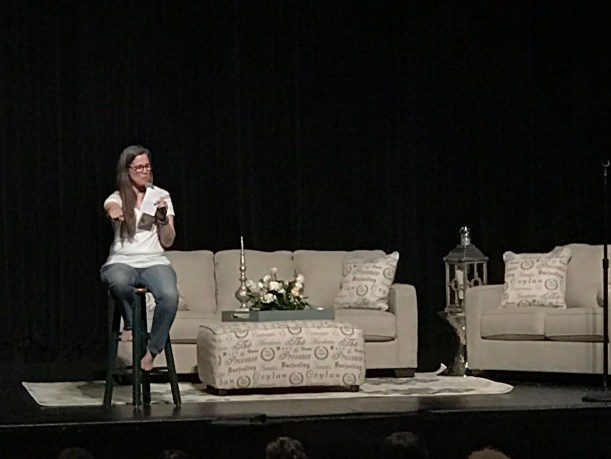
I preserved the conversational style of my talk, which I delivered from a very brief set of notes. This is a recreation, based on those few scratches, so I might be missing one or two comments as well as what I pulled in from other women’s talks. I purposely left out my notes on the creation of the poem and the narrative.

——

The Talk: Body, Memory, and Epiphany

As you learned during the performance of my poem, “The Physics of Epiphany (The Incident),” I was molested by neighborhood boys when I was three years old.

You might be thinking: She was only three. What could she possibly remember? The past should be left in the past.

Ah, but there’s the rub: The past doesn’t stay in the past, no matter how hard we try to deny it, lock it up, walk away from it. We — all of us — remember more than we think we do about the events in our lives. You see, memory isn’t a function of the mind alone. Recent research shows us that memories are created and stored by every cell in our bodies. Remembering past experiences, in fact, often happens first in the body, through the senses, and the mind fills in the story, or the intellectualized “facts,” of the situation for us.

Let’s try something, using a positive memory:

Close your eyes for a moment and take a few deep breaths to clear your mind. Now, think about a time when you were really happy — or, at least, content. Just stay there for a moment.

If you can, locate where you feel that happy or contented feeling in your body. Is it your chest? Your stomach? Your arms? Your hands? What does it physically feel like? Warmth? Tingling? Something else?

Now, focus on each of your senses. If you can, identify the sense that most connects you with that memory. Was it a smell — newly-mowed grass or the smell of bread in the oven or a loved-one’s scent, perhaps? Or something more visual, like a color or the way the light shimmered on leaves? Maybe it was a sound — birds, a song on the radio, a voice. It could even be the taste of a meal or the sensation of a breeze or the sun on your face, connecting you with touch.

(Open your eyes.)

When we spontaneously remember something, it’s not our minds that take us back; it’s our senses, our bodies. In fact:

The folks at Epona Equestrian Services in Arizona, where horses are used as therapeutic partners in the healing process, found that the gentle rocking motion their clients experience when riding a horse often dislodges memories of rape, incest, and other forms of sexual abuse or assault.

Not that long ago, a friend of mine got onto an elevator, followed by a man — a complete stranger — who happened to be wearing the same cologne as one who’d sexually assaulted her years before. She bolted from the elevator, quivering and sickened with the very same terror she experienced during the original attack.

And me? How could being molested at age three possibly affect me? I honestly didn’t think I had anything more than an intellectual memory of the event until rehearsing “Epiphany” to perform for you today. As I walked myself through my description of “the incident,” another incident from my recent past suddenly struck me. For over a year, I practiced a martial art called aikido. The men and women at the dojo where I trained were some of the most generous, kind, and gentle people I’ve ever met — they were like otters at play, falling, rolling, laughing. We all took care of and with one another, which is one of the main principles of aikido. But every time one of those kind, gentle-hearted men grabbed my wrist to practice a hold, I went stiff as a board. They used to joke with me: “Loosen up! Relax!” and I’d respond — still tight and starting to grow inexplicably angry — “I am relaxed!”

Without my understanding it at the time, they were holding my wrists. Making me feel trapped. Like those boys who held me hostage through the fence that day.

Epiphany.

What each of these examples illustrates is that repressed memories can ambush us. We have no control over where or when they’ll trigger. And we never know with what intensity they’ll surface. That’s the problem with trying to leave the past in the past. It doesn’t stay put. If you’re going to heal it, release it, be free of it, you have to drag it out into the light and deal with it. If you don’t, if you try to deny its impact on you, it could simply quietly prick at your attention as that nagging, vaguely disturbing distortion of the familiar — but it could also escalate into an emotionally violent freight train when the memory becomes too urgent to ignore.

Decades after being molested as a small child, and largely as the result of writing and rehearsing the poem, I’m looking anew at behaviors and feelings that have often perplexed me. Although I’d long ago dismissed the incident as something I was “over,” something requiring no attention, I’m beginning to wonder just how deeply and in what forms its effects are hidden.

I’ve been fortunate to work with some talented therapists over the years, who have guided me through talk therapy. Not long ago, a wonderful therapist led me through an EMDR session — Eye Movement Desensitization and Reprocessing, which leverages physical eye movements similar to REM (or to the eye movements we unconsciously make when consciously trying to access a memory) to help me recall and re-process another, unrelated traumatic event from my childhood. I’ve also developed skills on my own, like meditation and yoga, to help me integrate what I learn about myself when I poke around in the shadows of my memory. Is the healing difficult? Yes. Painful? Sometimes, yes. But it’s the path to freedom, and I’m happy to walk it.

If I were going to leave you with anything, it would be this: There is help out there. Those of us who are haunted by some buried or half-remembered trauma can reclaim our power. With the help and guidance of a trained professional and support from the people we love, we can break the grip of what holds us hostage through the fences our minds erect. Approaches like EMDR can accelerate the recovery and processing of traumatic memories in a safe and controlled environment so we aren’t ambushed by horrifying responses to hidden emotional triggers. Through tools like meditation we can learn to accept our feelings, integrate the work we do in therapy, and make peace with the past instead of trying to stuff away in a closet from which it will surely escape: as outbursts, meltdowns, even physical disease.

We need to trust our bodies’ signals, overcome our fear and shame, and ask for the help and resources we need to heal ourselves of past hurts. Wounds never go away completely. We can’t un-know what we know. But we can close that gaping wound and let it scar over. And learn to live with the scars in a way that’s less frightening, less limiting, more joyful. It’s possible.

It’s not easy. It requires courage and determination. And it will take time. But I can tell you that, for me, freeing myself of the grip of the past has most definitely been worth the work.


5 Comments

Esther Be Gather, Indianapolis – Part 1: The Poem

“I will tell you something about stories,

[he said]

They aren’t just entertainment.

Don’t be fooled.

They are all we have, you see,

all we have to fight off

illness and death.

You don’t have anything

if you don’t have the stories.”

— Leslie Marmon Silko, from Ceremony

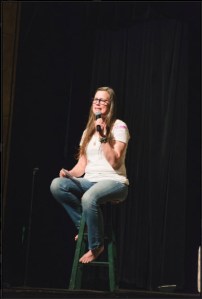
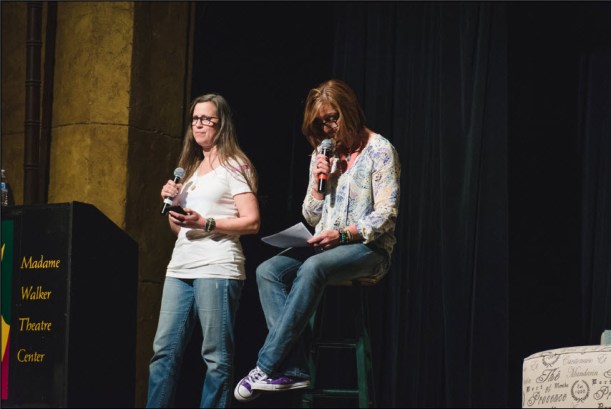
Back in April, I was honored to accept the invitation to be a Storyteller at the first Esther Be Gather, held here in Indianapolis at the historic Madame Walker Theater. Stacy Sallmen, Esther Be’s founder, has been organizing these events — here in the U.S., Europe, and Africa (to date) — as a means of providing everyday role models for women seeking to escape the damaging (and often dangerous) silence and inaction resulting from feelings shame, fear, and guilt. By gathering women to share their stories with others, Esther Be forges connections through common experience and inspires women to build the courage required to rise up and claim the resources they often refuse — in some cases at the cost of their lives — because of the shame, guilt, and fear associated with traumatic events or circumstances of their lives.

At this first Esther Be Gather, we heard stories from women who had not only survived but rose above such atrocities as rape and incest and abuse, as well as addiction, eating disorders, and pornography. Participants shared their stories in a number of ways: through talks, songs, audience participation. I chose to share mine, with the help of dear friend Kelli B. Schmith, through the medium most natural to me: poetry.

The piece wraps free verse (“The Physics of Epiphany”) around a narrative (“The Incident”). It reflects two experiences of memory: the intellectualized, emotionally stifled one and the spontaneous, emotionally explosive one in response to sensory recall. The poem portrays the violent battle fought between the mind, which seeks to suppress or sanitize traumatic memories to protect us from their impact, and the emotions, which are spontaneously triggered by sensory memory and often burst through the mind’s protective buffering with a range of intensity.
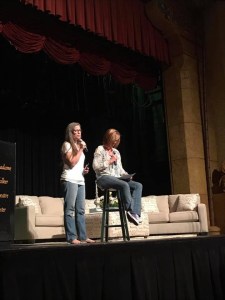
While my own delivery of the performance began with a tone of dismissive denial, racheting up to violent physicality, Kelli read the narrative with the quiet detachment many trauma victims use to tell stories — as though they were describing something that happened to someone else.

In a separate post, I’ll publish the re-creation of my brief talk about the role of the body in creating, recording, and storing memory — and why repressing memories can result in the violent eruptions of “epiphany” that many people suffer when those memories suddenly, often unexpectedly, surface again.

I’m publishing my talk separately, in part, to retrieve a little of the poem’s visceral impact, which it loses in its print form. But I also wanted to make the reader pause in the emotional intensity the poem creates before allowing them to move into the safer, cleaner intellectual space to which we reflexively retreat when faced with difficult feelings.

Because, while our theories and our analyses and our psychologies are fine, “[y]ou don’t have anything / if you don’t have the stories.”


The Poem: “The Physics of Epiphany (The Incident)”

It begins

as a faint shimmer in the distance

a subtle ripple

a vaguely disturbing distortion of the horizon

pricking at your attention.

But it’s still easy to dismiss

so you do.

My memory of the incident itself is vague, incomplete:

I am crying, my hands pulled through the fence and held fast on the other side so I can’t get away. They shush me again and again, intently focused on what they are doing. No one must hear this. It isn’t allowed.

By the next time you glance up,

it’s gathered speed,

gained momentum


and it’s heading straight at you.

My panties are pulled down, and through the fence, dirty fingers probe me. I remember nothing of this, specifically; only the tops of their heads as they whisper to one another with stifled laughter.

Your first instinct is to dodge it,

deflect it.

But you’re rooted to the spot

by its inescapable gravity,

the inevitable pull of its mass.

How did I get there? What had they used to lure me? For what had I reached my hands through the fence to grasp, only to be caught in this trap?

I don’t know. I was only three.

Your lungs suck for breath

as the first white-hot cannon ball of truth

slams into your gut

forcing your stomach back into your spine.

What I remember vividly is the sound the back door made as my father burst through it as though shot from a cannon, taking the stairs two at a time, his face twisted with rage.

You feel your body crumple,

curling inward around this thing

you don’t want to know

you don’t want to know

you don’t want to know

And my mother’s voice, high-pitched with terror, as she follows him, “Don’t hurt them! Don’t hurt them! They’re just boys!” her fear echoing forward and backward at once.

Forward and backward at once,

your whole being seems to spin around this new center.

And just when it seems

you can curl no tighter,

that every fiber of your being,

every cell every atom

has been pushed to its limit:


the equal and opposite reaction.

Reaction is slowed. The boys are transfixed, forgetting for a moment to release my wrists. I feel my father hit the ground behind me, and the spell is broken as he slams into the fence, a bellowing bull. The boys scatter, wild with terror. I remember one, the visiting friend of the neighbor boy who still had my smell on his fingers, scaling the opposite fence like a mad creature and disappearing down the street.

You implode

scattering what you once believed

was solid and real and firm

and stable – the very core

of your Self –

in all directions.


You desperately try

to hold it together

because

no no no NO

NO!

I remember my mother quickly pulling up my panties, hiding my dishonor. My father stands, shaking with impotence, the damage he could never undo settling into the pit of his stomach as I whimper and hide my face in my mother’s neck.

The MESS you’re making!


How will you clean this up?

How will you ever tuck this back in?

How will you piece together the splintered fragments

of the mask they all need you to wear –

Something my mother is saying to him about my trembling breaks through the thick, protective skin of my father’s anger, causing him to whirl and twisting his face in the other direction, from rage to naked anguish.

– your family

your friends

your coworkers?

This, too, I remember vividly: My father dropping to his knees, the tears welling, as he takes me tenderly by my tiny shoulders and looks deeply into my eyes, his own eyes desperately begging me to hear him. He’s helpless…shattered…undone.

But you’re helpless…shattered…undone.

There’s no going back from here.

No pretending your life

will ever be the same again.

Can ever be the same.

He says it so softly, so fiercely.

And then you feel it:


the peace

the acceptance

the expansiveness of the broken places

the light shining through…

“It wasn’t your fault, honey. You did nothing wrong.”

which starts as a shimmer, a subtle ripple

And he gently draws me into his arms

before defining a new horizon.

and cries.


Leave a comment

A Gift of Mary Oliver

For Mary Wrobel

In my hand
the book of poetry you sent:
a bouquet of words
fragrant syllables
delicious, full,
ripe verse.

A welcome,
unexpected joy.

May some drifting breeze
blow a seed of gratitude
across the miles
and plant itself
neatly, quietly
to bloom in your garden.


Leave a comment

Abandoned: A Gift from the Red Chair

Earlier this year, I participated in an online course that explored vulnerability through the use of photographic storytelling. The course was facilitated by brilliant St. Louis photographer-poet, Henry Lohmeyer. I’d started following Henry on Instagram some while back and was struck by the poignancy of not only his black-and-white photos but also his beautiful reflections on them. I was unprepared, however, for the depth and power of his deceptively simple daily prompts. I was equally unprepared for the plunge into the most shadowy corners of my heart — and (dare I say it?) soul. As difficult as it was to dig around in that darkness, Henry’s course — and the beautiful community of supportive and encouraging artists who were sharing their own journeys —  catalyzed the healing and release necessary for me to move toward the new life I am creating for myself and Bodhi. 

This post is an expansion and further exploration of one I created for the course.

Follow Henry on Instagram: @henrylohmeyer

——

The day’s prompt didn’t shake me as much as those from other mornings. I read the email, listened to the audio clip. I mulled for hours about where I might find a suitable place to photograph something “Abandoned”: old buildings; distant farmlands; deserted city lots. I racked my brain, getting no closer to a destination, so I decided to just go out and drive for a while.

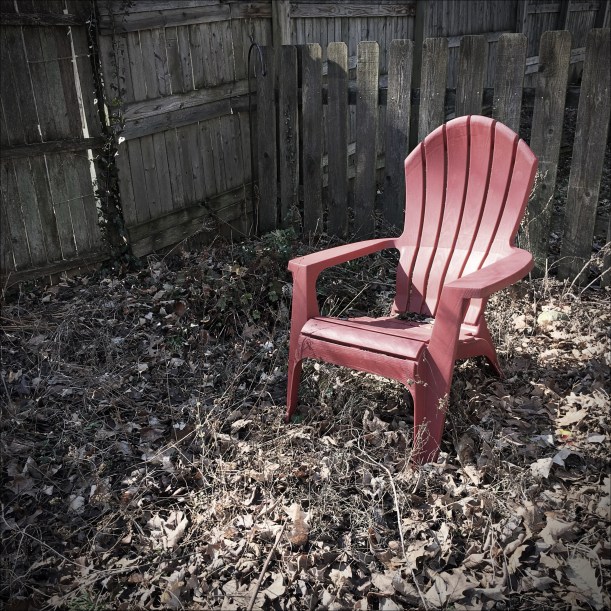
As I climbed into my truck, I glanced up and saw — really saw — that godforsaken red chair.

Mold streaked its fading red plastic, and weeds grew up through its slats on the little bit of overgrown garden where I’d discarded it three years ago. Over time, it became invisible to me, part of a deteriorating landscape I didn’t want to see because it reflected the slow, painful clenching of my heart. As I slowly climbed back out of the truck and slammed its door, I read reproach in the chair’s precarious tilt, in its sudden assertion of itself in the spotlight cast by an unexpected parting of the clouds. Fascinated and repulsed, I pulled my iPhone from my jacket pocket and went to work, capturing what was abandoned right here, outside my front door.

Reflections of Wholeness and Brokeness

In Arthurian legend, one of the major turning points in the story concerns the idea that “the land and the king are one.” The belief is far older and grislier than the tamer Arthurian romance version, where King Arthur is stricken with a deadly illness, and the land withers and dies with him, becoming a barren wasteland until he is healed.

I have both lived and died on this land. And it has lived and died with me.

Before I arrived, the property was all scrubby grass and tired trees. The house itself had been beautifully renovated from its previous decay, and the lot cleared of a thick wall of cedars that had acted as a screen for dark doings: insurance scams, drug trafficking, car theft. The surviving hardwoods almost sighed their relief with the changes, but the hard clay stubbornly held onto the roots of the past.

I almost immediately went about softening the soil with sand and compost, breaking beds from it in sweeping curves with a pickax and shovel. I sang as I dug in the soil and coaxed hand-seeded blooms from the earth. I tucked silvery-leafed plants among the tree roots and lacy ferns into the dappled shadows. I invited butterflies and hummingbirds to sip nectar from sun-warmed flowers. I practiced yoga and danced barefoot by candlelight on the covered porch, under flowering baskets I’d hung. I placed a red chair on the back deck from which I watched my dogs play in the thick, green grass. The land and I joyfully flourished together. It was a labor of love.

Then I experienced a love of a different kind. It was unhealthy, soul-stealing. Longing for the children I’d been putting off for too long and blinded by the lure of security, I married a man whom I believed would be my last chance. It was like living with an angry, tentacled creature. I found myself strangling, emotionally drained. Over time, I spent less and less time in my gardens, and they began to fade. Then I fell ill. The resulting surgeries included removing an ovary the doctors feared was cancerous. The pathology came back clear for cancer, but it was also clear that I would bear no children.

Throughout my illness, I begged my husband to leave me, leave my home. He worried about his “karma” — how it would look if he left while I was ill — even though he’d developed a deep disdain for me. I assured him I would heal more quickly in his absence. I was desperate. He was resolute. It was torture. I spent many hours tightly curled on the covered porch under the hanging baskets of flowers I no longer watered, letting my tears soak the dead, uncaring lumber while the living trees around me sagged.

It was months before he finally unwound himself from my life. I felt emptied out, disoriented. I buried a knife of shame deep into my heart. My mistakes were, in my mind, unforgivable.

Over the following years, as I withdrew into myself, into the pain and punishment of my choices, I let everything go. I gave up. I withered. And the gardens I’d worked so hard to bring to flower in this tough soil responded in kind. I’d abandoned not only them but all of the pleasure I’d felt in creating them, all of the pleasure I felt in creating at all. I didn’t know how I’d ever recover.

Then the final, crippling blow: The drainage system protecting my sweet little house’s foundation needed expensive repairs. The excavation would deeply scar the land. Worse, it would also destroy the back deck, where I loved to sip my morning tea from the red chair and listen to the birds sing as my dogs played. I removed everything from the deck and watched the construction crew shatter my tiny morning retreat space.

I set the red chair by the driveway and turned my back.  I slipped into the fog of a depression that lasted three years.

The Gift: Reclaiming Peace

Healing is a journey. And healing a heart is an arduous one. I’ve worked hard to walk my path to healing and have come farther than I could have imagined only a few months ago. Like my land once had, the hard clay of my heart stubbornly held onto the roots of the past. Unexpectedly, photographing the red chair and connecting with the story it told helped me uncover many of the wounds still keeping me stuck and slowly dig them from those deep, dark recesses where they’d been clinging.

I’ll be leaving this place soon. Not abandoning it, just moving on. My last gift — an expression of gratitude to the home that so tenderly held me as I fought my way back from grief and depression — has been to coax blooms from the neglected soil, resurrect my gardens, and nurture my trees. I’ve made my home bright and beautiful again, filled it with love and laughter. I’ve had the back deck rebuilt and decorated it with potted flowers and trees. I’ve scrubbed the red chair clean and placed a pretty pillow on it. I sip my morning tea there, nestled in its arms while birds sing and my dog happily chases his ball.

I’m at peace with myself and — thanks, in part, to an abandoned red chair — the blameless land, too, is at peace once more.


1 Comment

Knowing

I almost trashed this post. It’s an old one, recalling the pain of a loss that has healed over time. I wasn’t sure it was relevant anymore. But there’s something about the experience of grief — and of healing — that prompted me to go ahead and post it.

This is for my dear friends, Stacy and Jerry, each of whom lost someone they loved in the past week. And for my cousins, Cindy, Tom, and Penny, and their father, Herb, who so recently said goodbye to my Aunt Bert. Your loved ones are with you.

I know. 

——

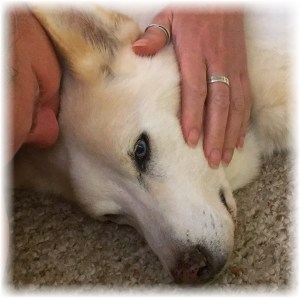
Some time ago, I had to drop a “specimen” off at the veterinarian — retesting Bodhi after a bout of giardia — and just inside the door was a sweet, ancient dog, at the very end of her leash, focusing all of her energy on balancing on her stick-thin legs. She had the most beautiful pale blue eyes, so I asked her mom if it was all right if I said hello, bending to stroke the frail head and murmur to the old girl how beautiful she was.

“She loves attention,” the woman said simply, but something in her voice made me look up — just in time to see that lone tear make its way down her cheek.

And I knew:

I knew from what depths of her being she had to dredge those few words.

I knew the effort required to choke them past the constriction in her throat.

I knew the full, bitter taste in her mouth as she struggled to shape it around these everyday words — ones she would never say again about this old, weak dog waiting for that last appointment.

I’d forced similar words through my own teeth about my Sachi, as my friends came to say goodbye the night before I released her soul. I’d choked on them as I’d walked my old Coyote so painfully slowly — at whatever pace she could manage — up and down our street, greeted by neighbors who loved and patted and fussed over her on her way to crossing. I battled tears, as this woman was now doing, and lost.

I gently kissed the old dog between her blue eyes before rising to wrap her mom in my arms. I stood there a few moments while this loving human emptied out her grief onto my shoulders, and I whispered to her that her sweet little girl would always be with her, beside her.

Because I know that, too.


Leave a comment

Canadian Giraffe Shortage Nearly Derails Yurt Purchase

From an email exchange, wherein our heroine attempts for several weeks to make contact with her preferred yurt-maker…

Me <4th email attempt>: “Hi there! I got your coupon, and I’m very interested, but your email keeps coming back undeliverable, and your voicemail seems to be full. Are you still out there? (Please, oh please, tell me you are!)”

Yurt-maker:

Me <a day later>: “Oooo! Oooo! My email didn’t come back undeliverable! So, I have hope! I also have questions: How much of a deposit do you need? How long does it take you to create and deliver orders? Can you deliver to North Carolina? Do any of your yurts come with giraffes pre-installed?”

Yurt-maker: “Thanks for your emails! I’m sorry we’ve been hard to reach…technical difficulties. Supplying the amount of giraffes requested by our clients has kept us busy! (Regarding giraffes: I’m sorry, but we’re sold out.) Have I exhausted your patience?”

Me: “Exhausted my patience? Nah. I just would have nagged you until you rallied the rest of Canada and invaded the US to make me stop emailing and calling you. (Although your giraffe shortage was nearly a deal-breaker.)”

Because that’s what it’s like to do business with me.

The pertinent bit:

I’m one step closer to getting my yurt ordered!

(sans giraffe)

“Nyah! Giraffe-less yurt for you!”


(Image courtesy Aidas Ciziunas, unsplash.com)